Lesson 8 — Space and time: a wavefront along a row
So far every PE had its own code() call and its own route rules. This lesson
runs one kernel on a whole row of PEs, and spreads a computation over the row
in space and over steps in time. The program aligns two DNA sequences with the Smith-Waterman algorithm:
each PE owns one column of the score matrix, and the rows of the matrix stream
through the PEs as a wavefront.
What you will be able to do
- Place one kernel on a row of PEs with a single
code(), and give each PE its own data withmiset. - Route a row with a colorpair, so that every PE sends and receives on one socket under the same two route rules.
- Close the two ends of a row with moats: one that feeds the row, one that absorbs what leaves it.
- Map a recurrence onto PEs and steps, and check the mapping by reading the cycle at which each value was computed.
The program
Smith-Waterman scores how well parts of a query sequence (Q bases) match parts
of a reference sequence (W bases). It fills a Q × W matrix H, row i for
query base i and column j for reference base j:
H[i][j] = max(0, H[i-1][j-1] + score(q[i], ref[j]), H[i-1][j] - 1, H[i][j-1] - 1)
score is +2 for a match and -1 for a mismatch; the two - 1 terms are gaps.
Cells outside the matrix count as 0. The largest H[i][j] is the score of the
best local alignment. Bases are coded A=1, C=2, G=3, T=4, and 0 pads a short
query and never matches.
The row has W + 2 PEs. PE j holds reference base j. A moat is a PE at the
edge of the computing region that supplies or absorbs its boundary data: the
left moat holds the query, and the right moat absorbs what the last PE sends.
  x=0           x=1        x=2              x=W          x=W+1
+-----------+  +-------+  +-------+       +---------+  +------------+
| left_moat |->| PE 0  |->| PE 1  |-> .. ->| PE W-1  |->| right_moat |
| query[]   |  | ref 0 |  | ref 1 |       | ref W-1 |  | absorbs    |
+-----------+  +-------+  +-------+       +---------+  +------------+
     every PE, moats included:  rp [CXR|R]  and  r [L|LXC]
Each arrow carries two hp values per step on one socket, r. The test
compares every cell of H with a Python reference (ref.py). The three rows
of test.rc:
| Row | W | Q | Sequences | Largest H |
|---|---|---|---|---|
tutorial | 32 | 16 | ACGT repeated: the query is part of the reference | 32, at H[15][15] |
snp | 32 | 16 | a 14-base query with one mismatched base | 25, at H[13][15] |
long | 8 | 40 | ACGT repeated: the reference is part of the query | 16, at H[7][7] |
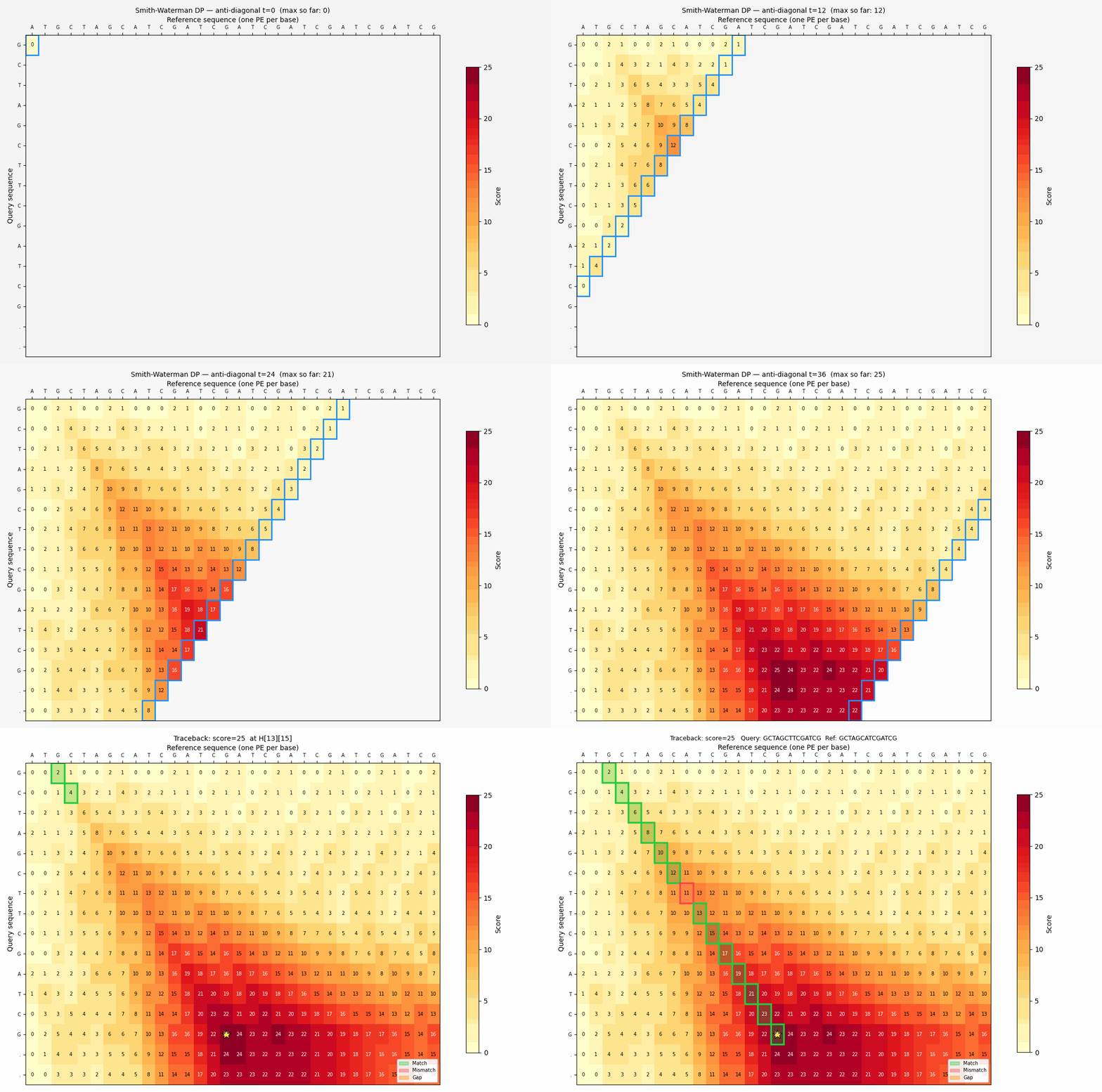
For snp, the best alignment has 13 matches and one mismatch: 13 × 2 - 1 = 25.
The mapping: a column per PE, a row per step
H[i][j] needs three neighbours: the cell above, H[i-1][j]; the cell to the
left, H[i][j-1]; and the diagonal, H[i-1][j-1]. Cells with the same
t = i + j form an anti-diagonal. Every cell on anti-diagonal t depends only
on anti-diagonals t - 1 and t - 2, so all of its cells can be computed at
once.
PE j computes column j, one row per iteration: iteration i computes
H[i][j]. PE j can start a row only when PE j-1 has sent it its value for
that row, so the PEs start one step apart, and at step t PE j works on row
t - j:
         PE 0     PE 1     PE 2     PE 3
t = 0:   H[0][0]
t = 1:   H[1][0]   H[0][1]
t = 2:   H[2][0]   H[1][1]   H[0][2]
t = 3:   H[3][0]   H[2][1]   H[1][2]   H[0][3]
This moving front is the wavefront. Each dependency has a place to live:
| Value | Computed by | How PE j gets it |
|---|---|---|
H[i-1][j], above | PE j, one iteration earlier | kept in h_above |
H[i][j-1], left | PE j-1 | received on r |
H[i-1][j-1], diagonal | PE j-1, one iteration earlier | the previous left value, kept in h_diag |
The query base q[i] travels with the left value: PE j-1 forwards it along
with H[i][j-1], so only the left moat stores the whole query. The matrix has W + Q - 1
anti-diagonals, so the run takes W + Q - 1 steps, not W × Q.
The code
The kernel, sw.w
Every one of the W PEs runs this file:
xp param Q = 16;

socket r;

xp ref_base[n=1];
hp history[n=Q];
u16 when[n=Q];

u16 tsc[1] address(0x7b30);
u16 tsc_control[1] address(0x7b34);
= 16givesQa default, which aQ:binding incode()overrides. The layout passesQ:Q, the value fromtest.rc.ref_baseholds this PE's reference base. It has no initializer:misetwrites a different value into each PE's copy (below).history[i]keepsH[i][j], so the test reads the whole matrix from the PEs afterwards.when[i]keeps the timestamp at which the PE finished rowi, read from the timestamp counter of lesson 3.ris the only socket: the PE receives on it and sends on it.
The program starts the counter and the two values a PE keeps between rows:
    tsc_control[0] <- tsc_control[0] | 4;

    hp h_above;
    hp h_diag;
    h_above <- 0:hp;
    h_diag  <- 0:hp;
Both start at 0, the matrix's row -1.
The loop body is one cell:
    let i in [0, Q);
    ∀i {
        hp h_left;
        hp q_char;
        h_left <- r[];
        q_char <- r[];

        // Code 0 pads a short query and matches nothing.
        hp score;
        if (q_char == (hp)ref_base[0] && q_char != 0:hp) {
            score <- 2:hp;
        } else {
            score <- -1:hp;
        }

        hp from_diag;  from_diag  <- h_diag  + score;
        hp from_above; from_above <- h_above - 1:hp;
        hp from_left;  from_left  <- h_left  - 1:hp;

        hp h_new;
        h_new <- 0:hp;
        if (from_diag  > h_new) h_new <- from_diag;
        if (from_above > h_new) h_new <- from_above;
        if (from_left  > h_new) h_new <- from_left;

        history[i] <- h_new;

        // Row i+1 needs H[i][j-1] as its diagonal and H[i][j] as above.
        h_diag  <- h_left;
        h_above <- h_new;

        r[] <- h_new;
        r[] <- q_char;
        when[i] <- tsc[0];
    }
The loop variable i is the query row. It is not the anti-diagonal t: the PE
never needs t, because each iteration waits for its left neighbour's values.
Two values travel per step on one socket: H[i][j] first, then q[i]. Nothing
in a wavelet says which is which, so the receiver reads them in the order they
were sent.
The scores are small integers, which hp holds exactly up to 2048. A match adds
2, so no score exceeds 2 × min(Q, W).
The moats
The left moat, moat_left.w, sends what PE 0's missing left neighbour would
send: H[i][-1] = 0 and the query base.
    let i in [0, Q);
    ∀i {
        r[] <- 0:hp;
        r[] <- (hp)query[i];
    }
The right moat, moat_right.w, reads every wavelet the last PE sends and
discards it:
    forever dispatch(r) {
        wavelet() { }
    }
It is the handler with no arguments from
lesson 7: it runs once per
full data wavelet and needs no count. The last PE sends two plain hp values
per step, and they share one wavelet, so the handler runs once per step: with a
counter in it, it ran 16 times for Q = 16. Lesson 7 warns that a handler counts
wavelets, not values; that does no harm here, because the handler only
discards.
wavelet is the reserved name for the handler of plain data wavelets. A handler
with any other name, such as edge() { }, is a named message (lesson 7), and
plain sends never run it: with a counter in it, it counted 0, and nothing
reported a problem. This moat still let the row finish, because the wavelets
are taken off its queue whether or not a handler runs. A moat that must answer
each wavelet, as in lesson 11, would never answer.
The right moat has to have code. Without a reader at the end of the row, the last PE's wavelets wait in the buffers of the router and the input queue, and once those are full its sends block, as in lesson 6. With no code on the right moat, the last PE finished 12 of its 16 rows.
One kernel on a rectangle
The layout, bench.paint, places sw.w on W PEs with one code() call:
let interior = rect(1 0 W 1 'j)
interior : code('sw [r:r Q:Q])
interior : name('grid)
rect(x y w h) is a w × h rectangle of PEs: columns x to x+w-1, rows
y to y+h-1.
One code() on it puts the same kernel, with the same parameters, on every PE
of the rectangle. Paint builds sw.w for the whole rectangle, not once per PE:
every PE runs the same compiled code, and only the data differ.
The quoted names after the size name the rectangle's dimensions,
rect(x y w h 'xdim 'ydim). Here the x dimension is called j, after the
matrix column. The map records it with every symbol of grid:
grid.ref_base                [ j<32 n<1          ] ( 0x0          1+j 0 )
grid.history                 [ j<32 n<16         ] ( 0x1+n        1+j 0 )
grid.history has dimensions j (32 PEs) and n (16 values). PE j sits at
fabric column 1 + j, and its history[n] at word 0x1 + n. A rectangle
dimension counts from the rectangle's own corner, not from column 0. Without a
name, Paint calls the dimensions x and y, and leaves out a dimension of size
1: this rectangle is one PE tall, so its y does not appear in these entries. A
named dimension stays in the map at any size, even 1.
Per-PE data with miset
The Makefile loads one reference base into each PE:
	miset image=$@ out=$@ map=bench.map \
	    symbol=grid.ref_base order="j n" data=ref.bin
	miset image=$@ out=$@ map=bench.map \
	    symbol=left_moat.query order="n" data=query.bin
order lists the symbol's dimensions, slowest first.
Lesson 2 used order="n" for one
PE. order="j n" reads ref.bin as one block of n values per PE, PE 0 first:
the file's W values go to the W PEs. Had the rectangle no names, its dimension
would be x, and the order "x n". display.py reads the results with order="n j":
history[0] of every PE, then history[1], which is H row by row.
The colorpair beach
A color takes its input from one port at a time
(lesson 4). PE j must
receive from the left and also send its own data right, which takes two inputs,
so it needs two colors. With two plain colors the rules would alternate from PE
to PE. A colorpair lets every PE use one socket and the same two rules:
let r  = color()
let rp = color()

let beach = rect(0 0 W+2 1)
beach : paint(rp [CXR|R])
beach : paint(r  [L|LXC])
beach : colorpair(r rp)
The beach is the rectangle that carries the routes: the W PEs and both moats.
colorpair(r rp) makes Paint number the two colors as partners, one apart
(r = rp ^ 1). In a rule, X takes the place of > and makes the color take
its input from its partner. Term by term:
| Term | in rp [CXR|R] | in r [L|LXC] |
|---|---|---|
| the color being routed | rp | r |
a | before the input | none | L|: on the left edge, no input from the left |
| the input | C, the core | L, the left neighbour |
X in place of > | read the partner: rp takes what the core sends on r | read the partner: r takes what arrives from the left on rp |
| the outputs | R, the right neighbour | C, the core |
a | after the outputs | |R: on the right edge, no output to the right | none |
Every PE reads and writes the one socket r, and the wavelets cross between
PEs on rp.
In this program the two | terms change nothing: the right moat never sends,
and nothing arrives from the left of the left moat. They keep the row's route
inside the row when an edge PE does send, or when the row sits next to other
PEs.
A | term acts at the edges of each rectangle the painted region is built
from, not at the outline of the region. Paint the rules on one rect that
covers the whole row, as beach does. See Pitfalls for what happens otherwise.
The union
union(beach interior left_moat right_moat)
union joins regions at their own positions. Here they overlap: beach
covers all W + 2 PEs and carries only routes, and the three code regions cover
parts of it and carry only code. Paint accepts the overlap because only one of
the overlapping regions has code on any PE. It rejects a union in which two
regions both put code on one PE, even the same kernel.
What the hardware does
The swap in the router
Each color in a router chooses which color it takes its input from. A color can
read its own color, or a color one or two numbers away. The choice is made
separately for the north/south inputs, the east/west inputs and the input from
the core, and the core's input can read only the color itself or its partner
c ^ 1. X sets all three to the partner. The router does the swap while
routing, with no work from the core.
       PE j's router                             PE j+1's router
core --r--> rp takes it (CXR) --rp, east--> r takes it (LXC) --r--> core
The architecture notes draw the same pattern.
Space and time, measured
make-log holds the when table for the first 16 PEs: the cycle at which PE
j finished row i.
The first rows and PEs of the tutorial row:
         PE 0   PE 1   PE 2   PE 3   PE 4   PE 5
i = 0:     42     86    130    174    215    259
i = 1:     84    125    172    216    260    301
i = 2:    126    170    211    258    302    346
i = 3:    168    212    256    297    344    388
Each PE has its own counter, which starts when its program enables it. In the
simulator, every PE starts its program,
and so its counter, in the same cycle, so the table can compare counters across
PEs. On the hardware, PEs do not all start together: there, compare only times
read on the same PE. The cells of one anti-diagonal finish within a few cycles
of each other: H[0][3], H[1][2], H[2][1] and H[3][0] at cycles 174, 172,
170 and 168.
A step takes about 43 cycles: the scalar work of one cell on one PE.
The last cell, H[15][31], finishes at cycle 2024: 47 anti-diagonals of about
43 cycles. The long row also has W + Q - 1 = 47 anti-diagonals, and its last
cell finishes at cycle 1964, although it computes 320 cells against 512. The
run time grows with W + Q, the number of anti-diagonals, not with the number of
cells. At most min(W, Q) PEs work at once: 16 of the 32 in tutorial, all 8 in
long.
Run it
In your copy of the tutorial (see Lesson 1):
cd tutorial/main-3-rows/08-wavefront
make TEST=tutorial
cat test-tutorial/make-log
Success is a line ending in PASS tutorial [ W=32 Q=16 SEED=0 ARCH=sdr ].
make-log shows the simulated matrix, the best alignment, the when table and
PASS: All 512 DP cells match the CPU reference. A failure prints FAIL, and
make-log lists the first mismatched cells. make TEST='*' runs all three
rows. After editing a file, run make clean first: make does not rebuild an
existing test-tutorial/. make animate TEST=snp writes the figure above to
test-snp/sw_animation.gif; it needs Python's matplotlib and Pillow.
Pitfalls
- Painting the row's rules on a joined region. With the two rules painted on
hstack(left_moat interior right_moat)instead ofbeach, Paint gives no message, but every PE gets its route input and output turned off. Nothing moves: every cell ofhistorystays 0, and the test fails. Paint the rules on onerect. - Sends and receives out of step. Every sender must send exactly two values per step. A third send, or a missing one, would shift every later value into the wrong variable, and nothing checks this.
- A wrong
orderstring.ordermust use the names in the map.order="x n"forgrid.ref_basefails with'x' is not a name or number, because the dimension is calledj.order="n"leavesjout, which asks for one value shared by every PE, somisetstops withref.bin: too long.
Exercise
Change the gap penalty from -1 to -2: the two - 1:hp gap terms in sw.w and
GAP in ref.py and display.py. Before you run it, predict the largest score
of the tutorial and snp rows, and which cells of the first query row change.
Then run make clean and make TEST='*'.
Next
Lesson 9 — Broadcast and reduce along a row computes on the stream itself: every PE adds its own vector to a running sum as it passes.
References
Source code
The Tungsten and Paint files of this example, as the toolset installs them under share/tutorial/main-3-rows/08-wavefront/. Select a line number to link to that line.